Sunscreen After 50: What Dermatology Guidelines Say

The American Academy of Dermatology's advice doesn't expire at 50: broad-spectrum, SPF 30 or higher, water-resistant, about an ounce for the body, reapplied every two hours outdoors, with shade and clothing doing much of the work.
In this article
The American Academy of Dermatology (AAD) recommends sunscreen as one part of protecting your skin from the sun's ultraviolet (UV) rays, together with shade and protective clothing. Its advice is the same at 55 as at 25: a broad-spectrum, water-resistant sunscreen with an SPF of 30 or higher on all skin that clothing doesn't cover, about 1 ounce for the body, reapplied about every two hours outdoors and after swimming or sweating.
That last part is where most people fall short. According to the AAD, most people apply only a quarter to half of the recommended amount, and many forget to reapply. Here's what the guidelines say, and how to make them part of an ordinary day.
What the AAD actually recommends
The AAD's recommendation comes down to three features on the label:
- Broad spectrum, meaning it protects against both UVA and UVB rays.
- SPF 30 or higher.
- Water resistant.
Beyond that, the AAD says the best sunscreen is "the one you will use again and again," whether lotion, cream, gel, stick or spray. For sensitive skin, dermatologists recommend mineral sunscreens, whose active ingredients are zinc oxide, titanium dioxide or both.
Why keep at it after 50? The National Institute on Aging (NIA) explains that UV light can damage skin cells and that the damage adds up over time. Is sun protection still worth it in your 60s and 70s? The AAD's answer: yes.
UVA, UVB and reading the label
Sunlight carries two kinds of UV rays:
- UVB rays are the main cause of sunburn. Window glass blocks them.
- UVA rays contribute to early skin aging, and they can pass through window glass.
The AAD says overexposure to either kind can be harmful, which is why "broad spectrum" on the label matters.
What SPF does and doesn't tell you
According to the Food and Drug Administration (FDA), SPF indicates the level of sunburn protection, which is mostly about UVB. The AAD explains that SPF 30 blocks about 97 percent of UVB rays; higher numbers block slightly more, but none blocks 100 percent, and a higher SPF doesn't last any longer between applications.
Three label checks
- "Broad Spectrum." Under FDA rules, sunscreens that aren't broad spectrum, or have an SPF below 15, must carry a "Skin Cancer/Skin Aging Alert" warning that says they've been shown only to help prevent sunburn. (The FDA's minimum is SPF 15; the AAD recommends 30 or higher.)
- "Water Resistant (40 minutes)" or "(80 minutes)." The FDA requires water-resistant sunscreens to say which, meaning how long they stay effective while you swim or sweat. No sunscreen is "waterproof" or "sweatproof"; manufacturers aren't allowed to use those words.
- The expiration date. The AAD notes that the FDA requires sunscreens to keep their original strength for at least three years. Throw out a bottle past its date, or one whose color or texture has changed, and keep sunscreen out of hot places like a parked car, which speeds up the breakdown of its ingredients.
How much to use and when
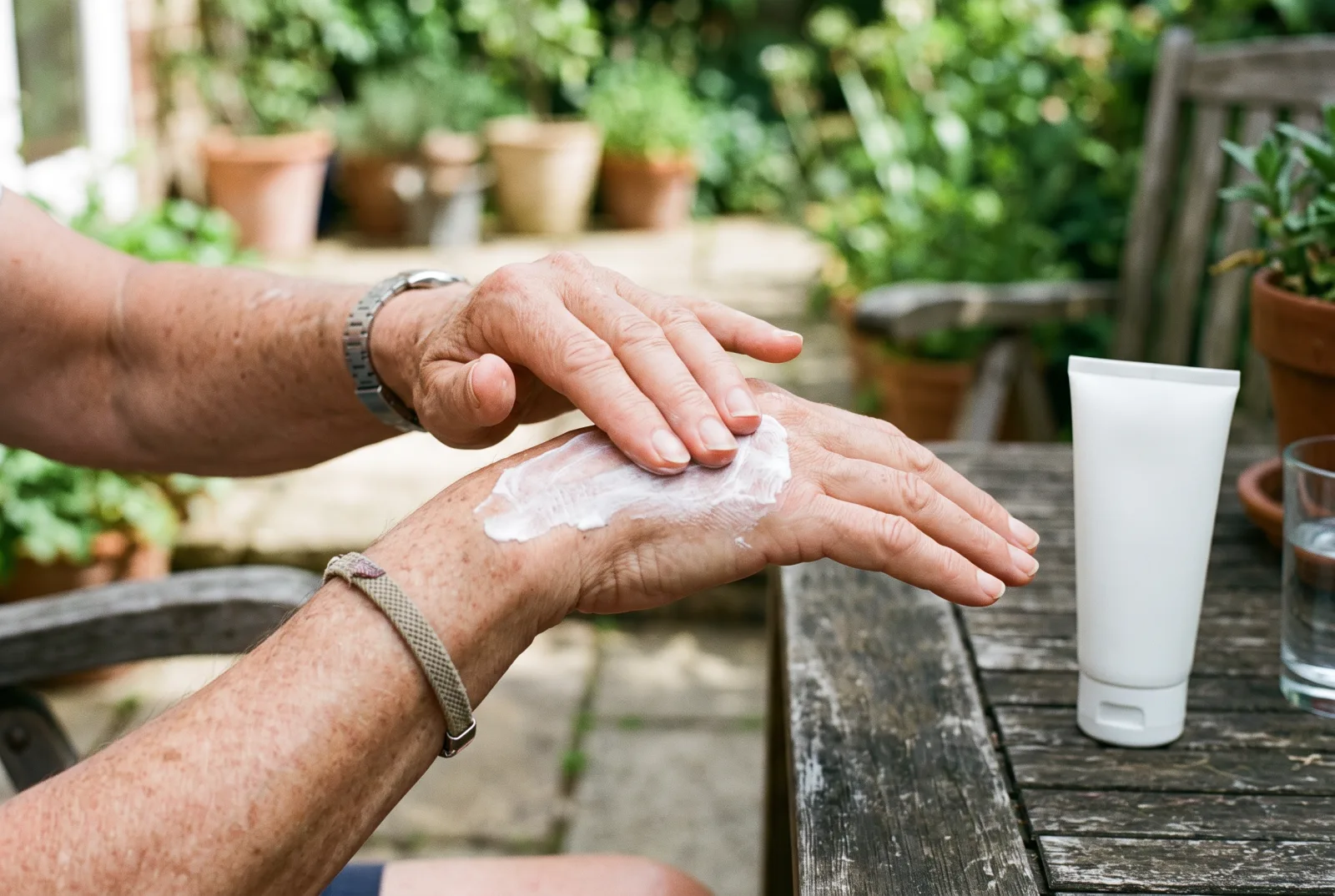
The AAD's "how much" guidance is specific:
- Body: at a minimum, most adults need about 1 ounce, roughly enough to fill a shot glass, to cover skin not covered by clothing. Depending on your size, you may need more.
- Face: at least 1 teaspoon, about enough to cover the length of your index and middle fingers.
- Timing: apply to dry skin about 15 minutes before you go outside.
- Reapply about every two hours while you're outdoors, and right after swimming or sweating.
Spots the AAD reminds people to cover: the neck, face, ears, tops of the feet, and legs. If your hair is thinning, put sunscreen on your scalp or wear a wide-brimmed hat. For your lips, use a lip balm with SPF 30 or higher. For your back, ask someone to help.
Reapplying is the step that slips. In AAD surveys, 65 percent of people said they often forget to reapply, and only about a third reapply every two hours while outside.
Everyday sun exposure counts too
The AAD points out that your skin is exposed to UV rays every time you go outside, even on cloudy days and in winter, so a walk around the neighborhood counts. A few easy-to-miss situations:
- Cloudy days. According to the AAD, up to 80 percent of the sun's UV rays can get through clouds. Yet its survey found only about 20 percent of Americans use sunscreen on cloudy days.
- Windows. UVA rays can pass through window glass, so time by a sunny window or a long daytime drive still means some UVA exposure.
- Water, snow and sand. These reflect the sun's rays, which the AAD says can increase your chance of sunburn.
- The garden. For people in their 60s and 70s, the AAD suggests gloves for gardening and housework, partly because of sun exposure.
What daily use looked like in one trial
In a randomized trial published in 2013 in the Annals of Internal Medicine, Hughes and colleagues followed 903 adults under 55 in Nambour, Australia. Some were randomly assigned to apply a broad-spectrum sunscreen every day; the others used sunscreen at their own discretion.
After four and a half years, the daily-sunscreen group showed no detectable increase in skin aging, measured by changes in the fine texture of the skin's surface, and 24 percent less skin aging than the discretionary group. It's one trial in one sunny place, with participants younger than 55, so it can't predict what will happen to any one person's skin. But the habit it tested was daily use, not just beach days.
Shade and clothing do much of the work

Sunscreen alone can't fully protect you, the AAD says. It also recommends:
- Seek shade, especially between 10 a.m. and 2 p.m., when the sun's rays are strongest. A handy check from the AAD: if your shadow is shorter than you are, seek shade.
- Wear lightweight long sleeves and long pants. Dark or bright colors in tightly woven fabrics protect better than light colors and see-through fabrics. The AAD's example: a long-sleeved denim shirt provides an SPF of about 1,700, while a white T-shirt provides about 7. Look for a UPF (ultraviolet protection factor) number on the label.
- Choose a wide-brimmed hat that shades your ears and neck as well as your head. The AAD says baseball caps and straw hats with holes aren't as effective.
- Wear sunglasses with UV protection. Dark lenses don't necessarily block UV, so check the label; large-framed or wraparound styles cover more.
Finally, the NIA suggests checking your skin often for any changes and visiting a dermatologist regularly. If something on your skin is new or changing, show it to your doctor.
The short version
- Use a broad-spectrum, water-resistant sunscreen, SPF 30 or higher, on all skin clothing doesn't cover.
- Use about 1 ounce for the body and 1 teaspoon for the face.
- Apply 15 minutes before going out, and reapply every two hours and after swimming or sweating.
- Don't skip the ears, neck, tops of the feet, scalp and lips, and remember cloudy days, winter and windows still count.
- Seek shade from 10 a.m. to 2 p.m., and wear long sleeves, a wide-brimmed hat and UV-blocking sunglasses.
Sources
- American Academy of Dermatology — How to apply sunscreen
- American Academy of Dermatology — Sunscreen FAQs
- American Academy of Dermatology — 5 common sunscreen mistakes — and how to avoid them
- American Academy of Dermatology — What to wear to protect your skin from the sun
- American Academy of Dermatology — How to care for your skin in your 60s and 70s
- U.S. Food and Drug Administration — Sunscreen: How to Help Protect Your Skin from the Sun
- National Institute on Aging — Skin Care and Aging
- National Institute on Aging — Tips for Healthier Skin as You Age
- Hughes MC, Williams GM, Baker P, Green AC — Sunscreen and prevention of skin aging: a randomized trial, Annals of Internal Medicine, 2013
This article is general information, not medical advice. Talk to your doctor before changing your diet, exercise or medication.