Are Afternoon Naps Good for You? What Studies Show
Short naps of about 10 to 20 minutes in the early afternoon are linked to better alertness with little grogginess. Longer or later naps can leave you foggy and eat into night sleep.
In this article
If you've ever felt your eyelids get heavy around 2 in the afternoon, you're in good company. Many people nap, and more of them do as the years go by. So is an afternoon nap a good habit or a bad one?
The research points to a fairly clear answer: it depends mostly on length and timing. Short naps of about 10 to 20 minutes, taken in the early afternoon, are linked to better alertness with little grogginess afterward. Longer naps are more likely to leave you foggy for a while, and late-day naps can make it harder to fall asleep at night. A strong need to nap most days is worth mentioning to your doctor.
Why the early afternoon feels sleepy
Two systems decide when you feel sleepy. According to the National Institute on Aging (NIA), your circadian rhythm, the body's internal clock, provides the timing for sleep. Alongside it runs your sleep drive: a chemical called adenosine builds up in your brain while you're awake and gets broken down while you sleep.
The clock doesn't produce sleepiness only at night. The Sleep Foundation explains that there are two peak periods for sleepiness in the daily cycle: the larger one at night, and a smaller one in the early afternoon. It's often called the post-lunch dip, and while lunch may play a part, it's linked to the circadian rhythm itself.
Napping also becomes more common with age. A review on sleep in normal aging cites a national survey of 7,664 people in Japan in which 27.4% of older adults napped frequently (four or more days a week), compared with 11.9% of young adults and 14.4% of middle-aged adults. Studies haven't clearly shown that older adults' naps last longer, though; mainly, they nap more often.
What the NASA nap study found
The best-known nap study comes from an unusual setting: the cockpit of a jumbo jet. In a 1994 NASA technical report, Mark Rosekind and colleagues studied pilots flying regularly scheduled trans-Pacific routes on Boeing 747s with three-person crews.
Twelve crew members were allowed a planned 40-minute rest period during the quiet cruise portion of the flight, taking turns napping in their seats. Nine others had a 40-minute control period in which they carried on with their usual duties.
Here's what the report found:
- The pilots fell asleep fast. The rest group slept on 93% of their opportunities, falling asleep in about 5.6 minutes and sleeping for about 26 minutes on average.
- Alertness and performance were better. The nap was associated with improved alertness and performance compared with the no-rest group. On a reaction-time test, the no-rest group was 10% to 16% slower than the rest group during the in-flight trials.
- The benefit lasted. The improvements held through descent and landing, the critical final phase of the flight.
- Layover sleep wasn't affected. The nap did not change how the pilots slept between flights.
The researchers also built in a 20-minute recovery period after each nap before a pilot went back to flying, to let any grogginess clear.
It's worth keeping the setting in mind. These were pilots on long-haul flights across time zones, some of them overnight, which is a very different situation from a quiet afternoon at home. Still, the study is a clear demonstration that a brief, planned nap can lift alertness when it's needed.
How long a nap should be
The National Heart, Lung, and Blood Institute (NHLBI) puts it simply: napping during the day may boost your alertness and performance, and adults should nap for no more than 20 minutes.
A 2006 study from Flinders University in Australia helps explain why. Researchers Brooks and Lack tested afternoon naps of 5, 10, 20 and 30 minutes of sleep in 24 healthy young adults who had slept only about 5 hours the night before. The naps were taken at 3 p.m.:
- 5 minutes produced few benefits compared with no nap.
- 10 minutes brought immediate improvements in sleepiness, fatigue, vigor and mental performance, with some benefits lasting up to 155 minutes.
- 20 minutes brought improvements that appeared about 35 minutes after waking and lasted up to 125 minutes.
- 30 minutes was followed by a period of impaired alertness and performance right after waking, before improvements set in.
That post-nap fog has a name: sleep inertia. A 2019 review by Cassie Hilditch and Andrew McHill describes it as the grogginess felt upon waking, along with dips in mental performance that fade the longer you're awake. The review notes it is less likely after short naps of 30 minutes or less, possibly because deep sleep typically doesn't begin until about 30 minutes in. Its advice for nappers: keep sleep under 30 minutes, with the caveat that even that doesn't guarantee a fog-free wake-up.
Keep in mind that these times refer to sleep itself. In the NASA study it took pilots about five and a half minutes to drift off, so your time lying down may run a little longer than your actual nap.
What about older adults? Research is thinner, but a small study from Hiroshima University looked at 10 healthy older adults who already napped at least three times a week. Compared with resting while watching TV, a 30-minute nap at 1 p.m. reduced afternoon sleepiness and fatigue and improved performance on tests. It's a small study of habitual nappers, so it shows what's possible rather than what everyone should do.
Timing your nap around night sleep
Timing matters for one simple reason: a nap spends some of the sleep drive you'd otherwise carry into bedtime. A long or late nap leaves less of it at night.
That's why guidance consistently points to earlier in the day:
- NIA advises older adults to avoid napping in the late afternoon or evening.
- NHLBI says that if you have trouble falling asleep at night, limit naps or take them earlier in the afternoon.
- The Sleep Foundation notes that experts typically recommend napping eight or more hours before bedtime, which for most people means before 3 p.m.
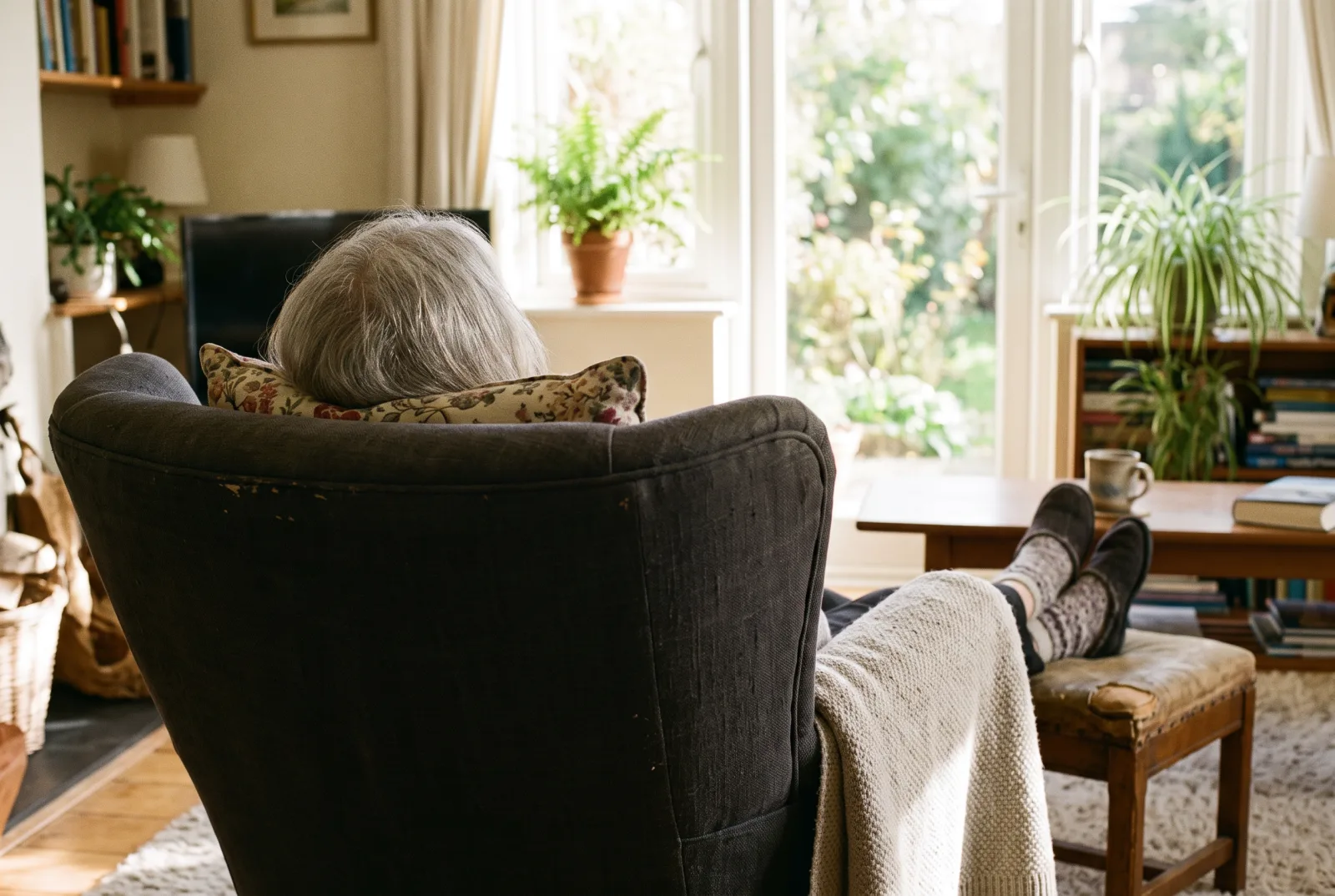
This advice matters more with age. Activity-tracking research summarized in the aging review found that older adults were more likely to nap in the early evening, while younger adults tended to nap in the afternoon. An evening doze in a favorite chair is exactly the kind of nap the guidance suggests avoiding.
When sleepiness is worth a mention
A nap now and then is ordinary. Needing one every day is a different signal. The aging review is direct on this point: excessive daytime sleepiness is not a part of normal aging, and it may be a sign of an underlying health problem.
NIA's advice is that if you're always sleepy, or you find it hard to get enough sleep at night, it may be time to talk with a doctor. The CDC lists feeling sleepy or tired even after getting enough sleep as a sign of poor sleep quality. Consider bringing it up if:
- You feel you need a nap most days, even after a full night in bed.
- Your naps are getting longer or more frequent than they used to be.
- You doze off during the day without meaning to.
The CDC suggests a sleep diary to help your provider see what's going on, noting when you go to bed, wake up during the night and in the morning, take naps, exercise, drink alcohol or caffeine, and take medications.
The short version: napping well
- Keep it short. About 10 to 20 minutes of sleep; NHLBI suggests no more than 20.
- Keep it early. Early afternoon, and generally before 3 p.m.
- Set an alarm. It helps you wake before deep sleep begins.
- Skip the evening doze. Late naps can make bedtime harder.
- Pay attention to patterns. Frequent, strong daytime sleepiness is worth raising with your doctor.
Sources
- Rosekind MR, et al. — Crew factors in flight operations 9: Effects of planned cockpit rest on crew performance and alertness in long-haul operations, NASA Technical Memorandum 108839, 1994
- National Heart, Lung, and Blood Institute — Healthy Sleep Habits
- Brooks A, Lack L. — A brief afternoon nap following nocturnal sleep restriction: which nap duration is most recuperative?, Sleep, 2006
- Hilditch CJ, McHill AW. — Sleep inertia: current insights, Nature and Science of Sleep, 2019
- Tamaki M, et al. — Restorative effects of a short afternoon nap (<30 min) in the elderly on subjective mood, performance and EEG activity, Sleep Research Online, 2000
- Li J, Vitiello MV, Gooneratne NS. — Sleep in Normal Aging, Sleep Medicine Clinics, 2018
- National Institute on Aging — Sleep and Older Adults
- Sleep Foundation — Napping: Benefits and Tips
- Centers for Disease Control and Prevention — About Sleep
This article is general information, not medical advice. Talk to your doctor before changing your diet, exercise or medication.